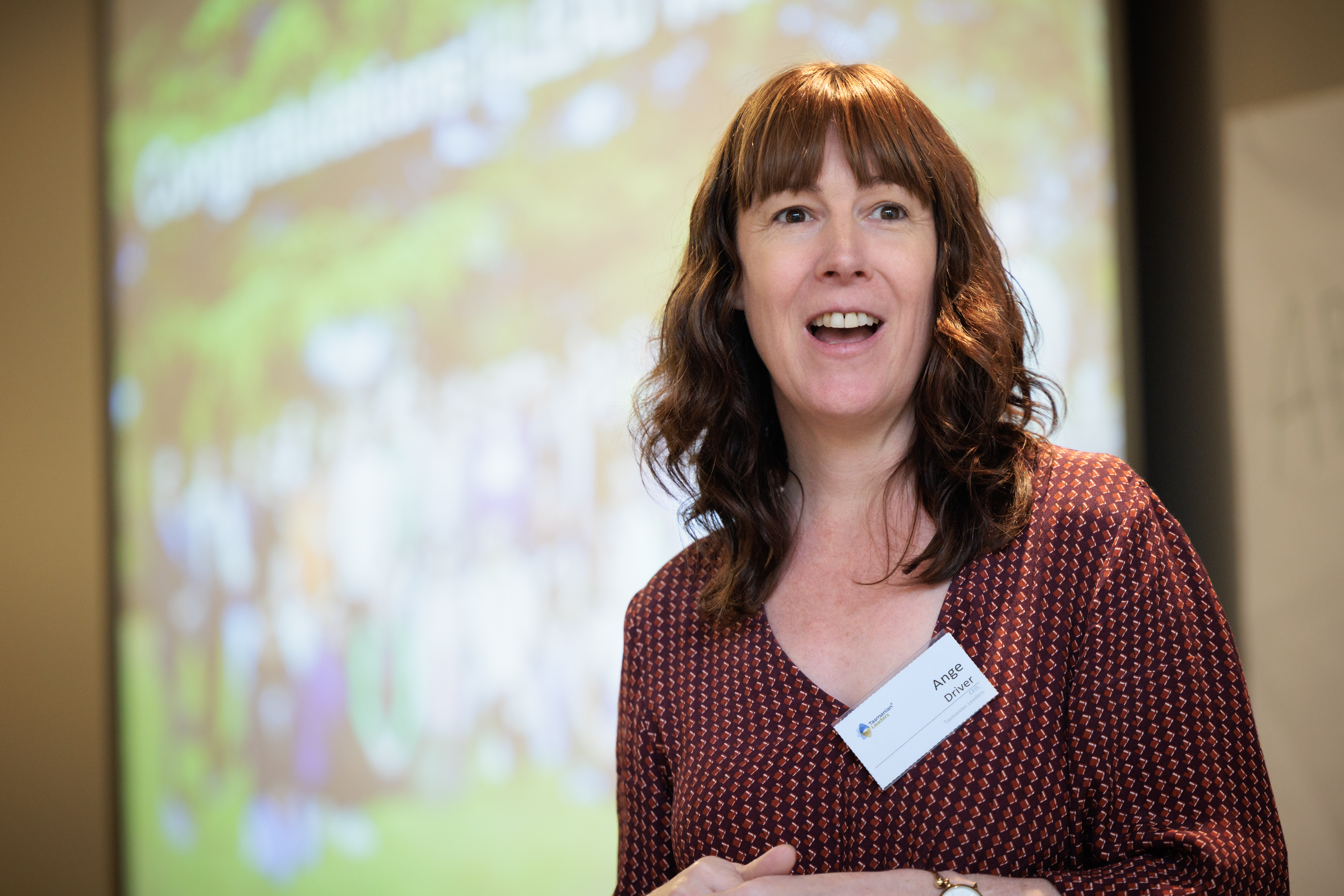
Angela Driver’s career has been shaped by a passion for leadership and community development.
With a background in performance art, she loves curating spaces where conversation and connection can flourish. For the past decade, she has led Tasmanian Leaders, working with individuals across every corner of the island state to help them navigate complexity in ways that strengthen economic, social, and environmental wellbeing.
Before that, Angela pursued similar goals through the power of the arts, with a particular focus on participatory theatre.
She joined IWFA because she loves connecting with people and engaging with fresh ideas and perspectives. Already, the conversations she has had with fellow Tassie members have been enlightening and energising.
1. Can you share a defining moment in your journey that has shaped how you lead?
I don’t have one dramatic lightning-bolt moment. Instead, it has been a series of small but powerful nudges from women who saw something in me before I saw it in myself. Years ago, Elizabeth Daly said very casually at the end of a Board meeting I took minutes for, “You should consider applying for a Churchill Fellowship.” Less than ten words was all it took for me to apply, and after being successful, I spent three months travelling the world exploring performance events for social change. It profoundly changed my thinking in ways and was very pleased to be able to channel my learning in the establishment of a new arts festival for Launceston, which is still going strong today.
Shortly after returning, another woman who had my back, Jane Bennett, suggested I apply for the Tasmanian Leaders Program. I did, and it too completely altered my career trajectory. Still pondering how to truly impact change, and questioning how far the arts could go, within two years of joining the Tasmanian Leaders Program I became the CEO. What I thought would be a three-year stint turned into a remarkable decade. Proof that sometimes others can spot your path long before you can. Being invited into IWFA feels like another one of those nudges. We should never underestimate the power of a well-timed nudge!
2. What do you think we can do to further women’s leadership in Australia today?
We can start by dropping the idea that women need to be “fixed.” We don’t. The systems around us do. And because systems are ruthless recruiters of the status quo, the work is frustratingly slow and requires patience and persistence. I also need to keep acknowledging my own privilege as a cis white woman and stay conscious of how I can support women whose identities and experiences differ from mine.
I currently love Professor Michelle Ryan’s work. After hearing about the glass cliff only two years ago, I now see them everywhere. The glass cliff is the pattern where women are most likely to be offered leadership roles when things are already going wrong — budgets shot, staff exhausted, public criticism rising, or the organisation in some kind of trouble. It means women are often asked to lead in the toughest moments, when the risk of failure is already baked in. If we want real progress, we need to rethink the context — not expect women to simply “try harder” or “lean in”.
3. What is one key leadership trait that will be essential in the next decade and why?
One? But there are so many we need! If I had to focus on just one trait, it would be sense-making. This is the ability to help people understand what’s shifting without pretending the world is simple. Sense-making takes time, and it’s my strong belief that as social animals, we need to be doing far more of it together, not alone in our heads or behind closed doors on keyboards. We are heading into a decade shaped by rapid technological change, climate pressures and a lot of competing worldviews, and people are craving leaders who can offer clarity without false certainty. The leaders who will do this well are the ones who can think deeply and creatively – who can analyse data and draw on moral reasoning, imagination and a sense of humanity to make meaning of it all.